“How much will a jewellery website cost?” is usually the first question a jeweller asks us. It’s a fair question, and the honest answer is that the build is only half of it. What you pay every month, on every order, matters just as much over three years.
This guide breaks down both: what it costs to build a jewellery e-commerce website in India in 2026, what it costs to run, and how Shopify, WooCommerce and a custom build compare for jewellers specifically.
The short answer
These are typical ranges we see in the market for a properly built jewellery store, not a ₹5,000 template. Your quote will depend on catalogue size, features and how much is custom-designed.
| Approach | Typical build cost | Main running costs |
|---|---|---|
| Shopify store with a customised theme | ₹60,000 – ₹1,50,000 | Shopify plan, paid apps, payment gateway fee plus Shopify’s own transaction fee |
| WooCommerce (WordPress) store | ₹80,000 – ₹2,50,000 | Good hosting, premium plugins, payment gateway fee, maintenance |
| Custom-built store (live metal pricing, ERP or B2B portal) | ₹3,00,000 onwards | Hosting, payment gateway fee, maintenance and development retainer |
The right choice depends less on the build price and more on how your prices work, how big your catalogue is, and who will run the store day to day.
Why jewellery stores cost more than ordinary online shops
A jewellery store looks like any other online shop, but several things underneath are different. Each one adds work, and each one is the reason a cheap template often fails for jewellers.
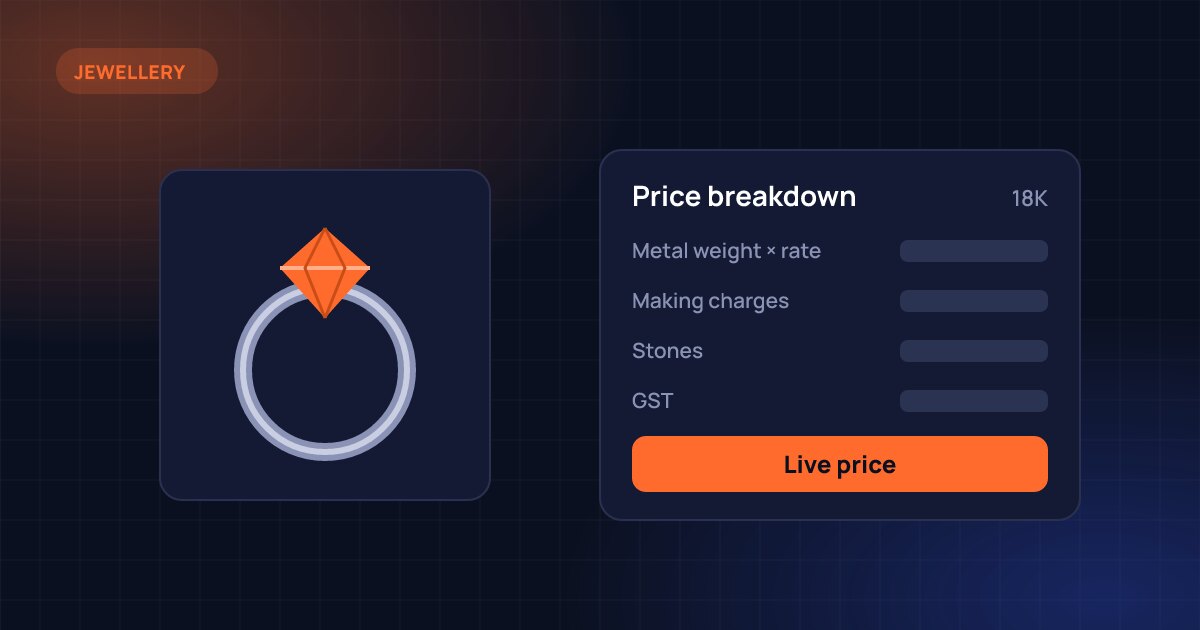
Prices that move every day. Most gold and silver jewellery is priced from the metal weight, the day’s rate for that purity, making charges, stone value and 3% GST. A normal store stores one fixed price per product. A jewellery store often needs a price formula, and a way for your team to update the rate every morning, or to pull it from a rate feed.
Variants that change the price. The same ring in 14K, 18K and 22K, or in sizes 10 to 20, can have a different weight and therefore a different price. Setting this up correctly takes planning.
Detailed product information. Metal and purity, gross and net weight, stone type and carat, certification, HUID and hallmark details, dimensions and care instructions. Buyers spending ₹50,000 want every detail. Our jewellery e-commerce checklist lists what to include.
Photography and video. Jewellery sells on photos. Close-ups, on-model shots and short videos cost more to produce than standard product photos, and need consistent styling across the catalogue.
Trust and compliance. BIS hallmarking with HUID is mandatory for gold jewellery sold in the districts covered by the rules, which had grown to 380 districts by March 2026. Silver hallmarking is voluntary, but since September 2025 hallmarked silver must also carry a HUID. Product pages should state these details clearly, along with your return and exchange policy, certificate details and secure, insured shipping.
High-value payments. Larger order values mean you need a payment gateway set up for higher limits, options such as EMI, and a clear policy on cash on delivery, which many jewellers limit or switch off above a certain value.
Shopify for jewellery stores
Shopify is a hosted platform: you pay a monthly plan and Shopify handles hosting, security and updates.
What it costs to run. Shopify’s plans are priced in US dollars. At the time of writing, the Basic plan works out to roughly ₹2,400 a month on annual billing (about ₹3,200 on monthly billing), and the Shopify plan to roughly ₹6,600 a month on annual billing (about ₹8,700 monthly). Check Shopify’s India pricing page for the current figures, as they move with the exchange rate.
The fee most jewellers miss. Shopify Payments is not available in India, so stores use a gateway such as Razorpay, PayU or Cashfree. When you do, Shopify charges its own transaction fee on top of the gateway’s fee: 2% on Basic, 1% on the Shopify plan and 0.5% on Advanced. For a business with high order values, this adds up quickly.
Apps. Gold-rate pricing, product options, reviews, WhatsApp, wishlists and advanced filters are often paid apps. Budget a few thousand rupees a month for these, more as the store grows.
Good fit when: your prices are mostly fixed (fashion or silver jewellery, gemstone pieces priced individually), you want to launch quickly, and you don’t want to manage hosting or updates.
WooCommerce for jewellery stores
WooCommerce is a free e-commerce plugin for WordPress. You host it yourself, so you control the code and the data.
What it costs to run. There’s no platform fee and no extra transaction fee, only your payment gateway’s charge. You pay for good hosting (a store with hundreds of high-resolution images needs more than cheap shared hosting), premium plugins for features like rate-based pricing, and regular maintenance: WordPress, the theme and plugins all need updates and security checks.
Good fit when: your prices follow the daily metal rate, you want full control over product data and pricing logic, or you want to integrate the store with your own systems later.
Watch out for: a store built by stacking dozens of plugins. It becomes slow and fragile. A well-built WooCommerce store uses a handful of reliable plugins and some custom code for the jewellery-specific parts.
Custom-built stores
A custom build makes sense for larger jewellers and manufacturers: live pricing from your own rate and stock data, connection to an ERP or billing software, a separate B2B portal with wholesale prices for approved buyers, or a catalogue of thousands of SKUs.
It costs more upfront, but you pay no platform fee, there’s no app sprawl, and the store does exactly what your business needs. If you already run production or billing software, the store can read stock, weights and prices directly from it instead of your team keying them in twice. We’ve built this kind of system for the jewellery trade, including custom software and ERP for production workflows.
The costs nobody puts in the quote
Whichever platform you choose, these are the costs that surprise jewellers most.
Payment fees on every order. Here’s a worked example for a ₹50,000 order, using Razorpay’s standard 2% fee plus 18% GST on the fee:
| Platform | Gateway fee (2% + GST) | Platform transaction fee | Total per ₹50,000 order |
|---|---|---|---|
| WooCommerce or custom | ₹1,180 | None | ₹1,180 |
| Shopify plan | ₹1,180 | ₹500 (1%) | ₹1,680 + taxes |
| Shopify Basic | ₹1,180 | ₹1,000 (2%) | ₹2,180 + taxes |
On 50 orders a month, the gap between the first and last rows is about ₹50,000 a month. Gateways sometimes run introductory offers, and rates can be negotiated at higher volumes, so check current pricing with your gateway.
Photography. Shooting a new collection properly costs real money. AI product photo editing can make existing photos consistent, clean up backgrounds and create on-model images without a full reshoot for every piece.
Product data. Someone has to enter weights, purities, stones and descriptions for every product. For large catalogues, AI-assisted catalogue content with human review saves weeks.
Insured shipping and packaging. High-value parcels need insured, trackable shipping, which costs more than standard courier rates.
Maintenance and security. Updates, backups, uptime monitoring and small changes. A website maintenance plan costs far less than fixing a hacked or broken store during the wedding season.
Marketing. A store without visitors sells nothing. Budget for SEO, Google Shopping and social media from the start. Google’s free product listings are available in India through Merchant Center, but you need a clean product feed and shipping settings set up correctly.
How to keep the cost under control
- Launch with your best-selling collections first. Add the rest of the catalogue once the store is working.
- Decide how your prices work before choosing a platform. If prices follow the daily rate, that decision alone may rule Shopify in or out.
- Fix photo styling before launch. Consistent photos make a small catalogue look premium; inconsistent ones make a large catalogue look cheap.
- Ask for a written scope with a fixed price. It should list every page, feature, integration and who supplies content.
- Make sure you own everything. The domain, the hosting or Shopify account, the content and the code should all be in your name.
Our experience
We’ve built and run online stores for jewellers since long before “D2C” was a word. For Silver & Gem Exports in Jaipur, we built their jewellery store and still look after its marketing and upkeep. Every jeweller’s pricing, catalogue and customers are different, which is why we don’t publish fixed packages.
If you’re planning a jewellery website, tell us about your catalogue and how you price your pieces, and we’ll send a written, fixed quote with a clear recommendation on Shopify, WooCommerce or a custom build. See our e-commerce development service for more.