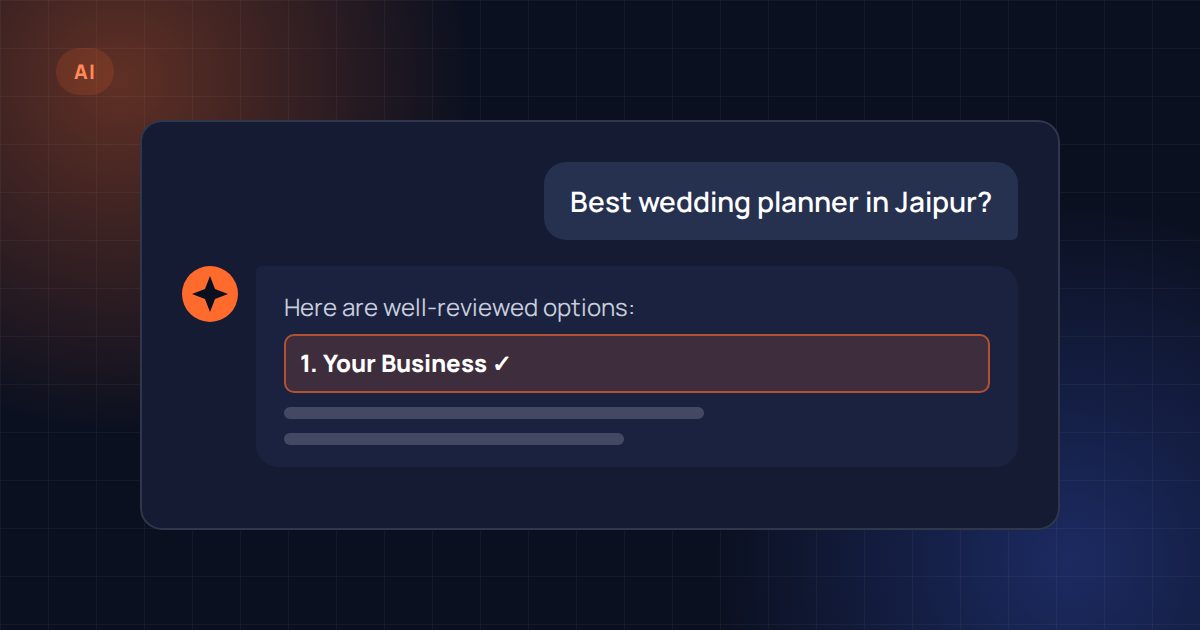
More customers now start with a question rather than a search. Instead of typing “wedding planner Jaipur” into Google, they ask ChatGPT, Perplexity or Google’s AI Overviews something like “Who are the best wedding planners in Jaipur for a destination wedding?” The answer names a handful of businesses, and many people never look further.
Being one of those names is the goal of generative engine optimisation (GEO). It isn’t magic and it isn’t a separate world from SEO. It’s about making your business easy for AI tools to find, understand and trust.
How AI assistants decide who to mention
AI assistants build answers from information they can find and verify. Broadly, they look for:
- Clear facts about your business: what you do, where you are, who you serve.
- Consistency: the same name, address, services and details across your website, Google Business Profile and other listings.
- Content that answers the question: pages that explain your services, prices or process, and real-world examples.
- Signals of trust: reviews, case studies, mentions on reputable websites, and a long-established presence.
If any of these are missing or contradictory, AI tools fill the gaps with information about other businesses.
1. Make your basic facts impossible to misunderstand
Start with the details an assistant needs to describe you correctly. Your homepage, About page and contact page should state, in plain words, what your business does, where it is based and who it serves. Avoid vague slogans in place of facts; “we build websites and run SEO for hotels in Jaipur” is far more useful to a machine than “we craft digital experiences”.
Then check that the same facts appear everywhere else: your Google Business Profile, social media profiles, directories and industry listings. Different spellings of your address or old phone numbers create doubt.
2. Add structured data to your website
Structured data (schema markup) states your key facts in a format machines read directly: your organisation, address, opening hours, services, products and FAQs. It removes guesswork and links your website, your profiles and your brand into one clear entity. Our guide to structured data for local businesses explains which types matter most.
3. Write pages that answer real questions
AI assistants favour content that answers questions directly. For each service you offer, make sure there is a page that explains:
- What the service includes and who it is for.
- How the process works and how long it takes.
- What affects the cost.
- Common questions, answered in a sentence or two each.
Clear headings and short, specific answers make it easy for an assistant to quote you accurately.
4. Show proof, not just promises
Assistants are more confident recommending businesses with visible evidence: case studies with real results, a portfolio of work, client names and reviews. Ask happy clients to leave reviews on your Google Business Profile, and publish examples of your work on your website.
5. Get mentioned in the right places
Mentions on trusted websites, such as industry associations, local news, directories and partner sites, help AI tools confirm that your business is real and relevant. Focus on quality and relevance rather than volume; a mention from an industry body is worth more than dozens of low-quality listings.
6. Keep regular SEO strong
AI answers often draw on pages that already rank well in Google. Technical health, fast pages, good content and quality links still matter. Think of GEO as a layer on top of SEO, not a replacement for it.
7. Check how AI tools describe you
Every few weeks, ask the main AI tools the questions your customers ask. Note whether your business appears, how it is described and which sources are cited. If an assistant gets something wrong, find where that information came from and correct it at the source.
Where to start
If you do three things this month, make them these: state your core facts clearly on your website, make them consistent across your listings, and add structured data. Most businesses haven’t done even this, which makes it a real opportunity.
If you’d like a check of how AI tools currently see your business, our AI search optimisation (GEO) service starts with exactly that.